


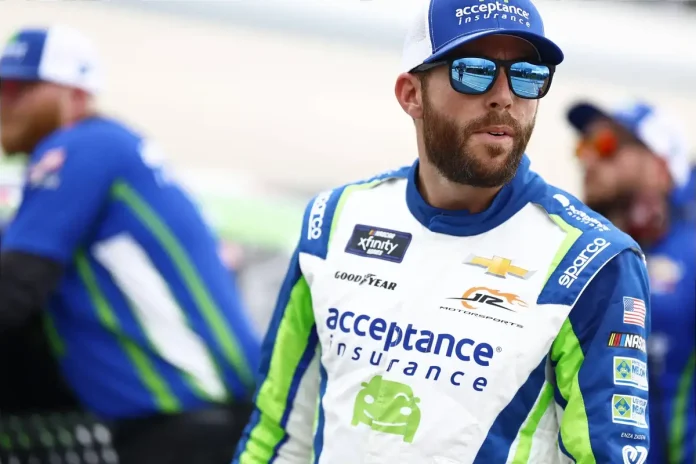
In a tale that could only be rivaled by a Hollywood script, Ross Chastain’s journey from the brink of triumph to the depths of despair unfolded dramatically around the holiday season of 2019. As Christmas bells rang, the Florida native found himself entangled in the sinister web of the DC Solar scandal, a shocking narrative that shook the NASCAR community to its core.
Chastain, who once basked in the glow of a promising career—three races under the DC Solar banner and a victorious debut—was blindsided when the very foundation of his racing dreams began to crumble. Just days after a lavish Christmas party featuring the iconic Pitbull flying in on his private jet, the joyous atmosphere turned to chaos. “Two days after the party. I didn’t hear it two days after the raid cus they all went silent out there,” Chastain recounted during a candid appearance on the Dinner with Racers podcast. The illusion of success shattered when the FBI descended upon the home of DC Solar CEO Jeff Carpoff, a man who had championed Chastain’s career at a crucial time.
The investigation revealed a dark underbelly of conspiracy, wire fraud, and money laundering, leading to Carpoff’s staggering 30-year prison sentence. The shocking revelations sent shockwaves through the NASCAR world, leaving Chastain grappling with the fallout. His association with DC Solar, once a source of hope, became a perilous liability, igniting a series of events that left him without a ride, as Chip Ganassi Racing abruptly shuttered its Xfinity Series program.
Chastain’s story is not merely one of lost sponsorship but a stark reminder of the precarious balance between talent and funding in motorsport. With roots tracing back to the watermelon fields of southern Florida, Chastain’s ascent in NASCAR was fueled by sheer determination rather than deep pockets. “That struggle never really ends,” he reflected. The harsh truth of racing is that while skill is vital, it is money that often determines success. The cost to compete at a competitive level is daunting, with Chastain revealing, “For my team to be competitive costs about $50,000 a race.”
As the news of the raid spread, the impact on Chastain was devastating. The dream he had fought for was suddenly a mirage, and the financial realities of the sport became brutally evident. The collapse of sponsorships and the loss of his racing seat felt like a death knell to his aspirations.
In the aftermath of the chaos, Chastain learned invaluable lessons about resilience and the unforgiving nature of his profession. Each race brought a hefty price tag, and without significant backing, his chances of making a mark in the sport dwindled. “We figured we might be able to run one race, but after that, we would be out of people and money,” he lamented, highlighting the relentless grind that defines the lives of many drivers.
Today, as a driver for Trackhouse Racing, Chastain stands on steadier ground, but the echoes of his tumultuous past resonate deeply within him. His experiences serve as a cautionary tale for aspiring racers, a stark reminder that in NASCAR, the line between success and disaster can sometimes blur in the blink of an eye. Chastain’s journey is a powerful testament to the trials faced by drivers outside the spotlight, navigating the treacherous waters of sponsorship and survival in a sport driven as much by dollars as by speed.