


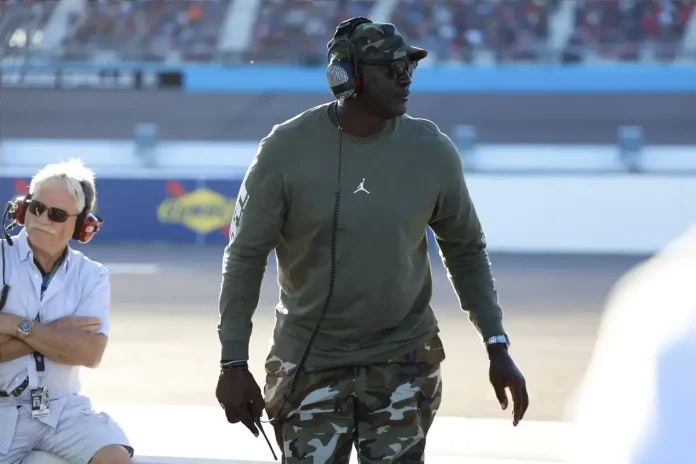
Michael Jordan has emerged victorious in a courtroom drama that has shaken the very foundations of NASCAR. As he awaited the verdict outside the federal courthouse in Charlotte on December 11, 2025, the legendary basketball icon was accompanied by Denny Hamlin and Bob Jenkins of Front Row Motorsports, marking a pivotal moment in the sport’s history. “Today’s a good day,” Jordan declared, embodying the fierce competitor he has always been, as this nine-day trial reached its explosive conclusion.
The roots of this legal battle stretch back to 2024 when Jordan’s 23XI Racing took a bold stand against what they deemed unjust charter agreements. This lawsuit not only exposed the France family’s longstanding dominance over NASCAR but also sparked a fierce pushback from teams seeking more equitable terms. With the dawn of 2026 approaching, the dynamics of NASCAR’s power structure have been irrevocably altered.
The dust has settled, and the implications of this lawsuit are far-reaching. Denny Hamlin has extended an olive branch to Jim France, leading to a settlement that restores charters to teams like 23XI Racing and Front Row Motorsports, alleviating their previous fears of being left without vital race participation. This settlement is not just a victory on paper; it is rumored to include substantial financial compensation that recognizes the hardships faced during a tumultuous 2025 season, where the economic impact was estimated to exceed $300 million.
In a significant shift, NASCAR has now embraced the concept of permanent charters, a move reminiscent of collective bargaining agreements seen in leagues like the NFL and NBA. This new approach allows teams to negotiate financial terms that must be approved by a supermajority, ensuring that decisions reflect the interests of the majority rather than a select few.
NASCAR’s strategic maneuvering extends to increasing its share of charter transactions from 2% to 10%, positioning itself favorably as team valuations soar into nine-figure territory. Jordan advocated for unity among stakeholders, stating, “I’m thrilled that we are moving forward together rather than apart. For the sport to expand, we need to find a collaborative approach between the two sides.” His attorney, Jeffrey Kessler, underscored the broader implications of the lawsuit, emphasizing that the ultimate goal was to create a solution benefiting all involved.
However, the road ahead is still fraught with challenges. The future of Richard Childress’s testimony looms large, with potential legal repercussions stemming from derogatory remarks made by NASCAR President Steve Phelps. Childress’s relationship with the ongoing settlement discussions is complex, especially as public sentiments towards NASCAR leadership wane. Bass Pro Shops founder Johnny Morris has voiced his concerns, urging the France family and team owners to prioritize the integrity of NASCAR over personal grievances.
The “silly season” is already underway, with driver contracts for the upcoming 2026 season hanging in the balance. The newfound value of teams, bolstered by the introduction of evergreen charters, could lead to a talent acquisition frenzy, as top teams like Hendrick Motorsports and Team Penske position themselves to attract the best drivers available.
NASCAR found itself cornered, with little choice but to pursue a settlement. The organization’s top brass had appeared defensive in court, struggling to justify their decisions amid looming threats from rival series. Their frequent lapses in memory during testimony only fueled doubts about their integrity and motives, leading to a challenging landscape for a robust defense.
As new agreements are finalized and the focus shifts back to the racetrack, the determination displayed by Jordan and his allies signals that the negotiations ahead will be fierce. The question remains: can NASCAR truly recover from this legal upheaval and restore its image in the eyes of fans and teams alike? Only time will tell, but one thing is clear: the landscape of NASCAR has changed forever, and the stakes have never been higher.