


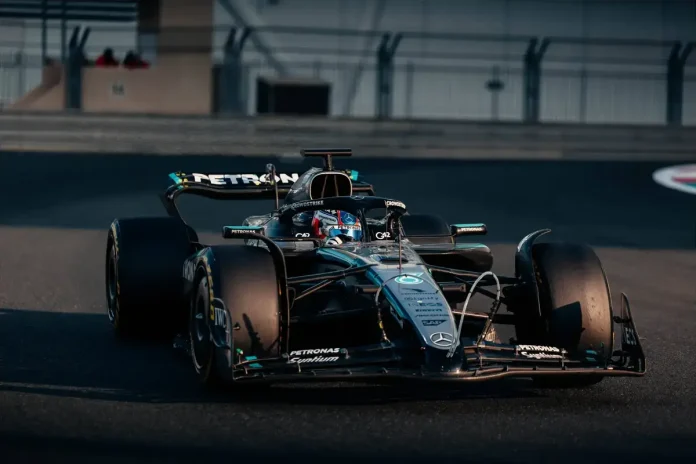
Kimi Antonelli, the rising star of Mercedes, is poised to leverage his unique skills as the Formula 1 landscape undergoes a seismic shift with new regulations this season. The 19-year-old prodigy, who made a commendable debut last year, is now faced with the daunting task of adapting to a radically different car and racing style. However, trackside engineering director Andrew Shovlin believes that Antonelli’s ability to harness his “spare mental capacity” – a trait honed through countless hours of gaming – will set him apart in this new era of F1.
As Antonelli embarks on this fresh chapter, he carries the weight of a season that showcased both brilliance and challenges. His performance was characterized by a spectacular start and finish, contrasted sharply by a mid-season slump during the European races. Now, as the rules are rewritten, he must recalibrate his approach to extract maximum performance in both qualifying and race scenarios. Shovlin is optimistic, noting that Antonelli has become increasingly comfortable within the team and with his own capabilities. “We’re starting to understand him a lot better,” he said, emphasizing the young driver’s growing confidence and the anticipation surrounding his potential this year.
The transition to new regulations will hinge on Antonelli’s ability to adapt, and Shovlin highlights his impressive dedication to simulator practice. “Kimi, because he’s a youngster, has a pretty impressive ability to sit in the sim and drive it all day long,” Shovlin remarked. This dedication is not merely about practicing; it’s about developing a mental agility that enables Antonelli to strategize while driving. The ability to multitask in high-pressure situations is a hallmark of younger drivers who have grown up in the gaming world, and it’s a skill that can be pivotal on the racetrack.
Shovlin praised Antonelli’s growth throughout the previous season, particularly his improved understanding of race dynamics and engineering tools. His collaboration with race engineer Pete Bonnington has allowed him to articulate the car’s performance more effectively. “Because Kimi can describe to Bono exactly what the car is doing, Bono knows what to do with it,” Shovlin explained, highlighting the importance of communication in fine-tuning the vehicle’s balance and performance. This synergy not only enhances Antonelli’s racing but also contributes to a deeper understanding of the intricate mechanics behind it.
Despite his undeniable talent, there are areas where Antonelli must sharpen his skills, particularly in race execution and pacing. Shovlin pointed out that last season, Antonelli struggled with managing his speed, often finding himself on the edge of overexertion. This was especially evident during the qualifying sessions, where his eagerness sometimes led to mistakes. “He just overcooked it,” Shovlin noted, referencing a particularly disappointing 15th place finish at the Hungarian Grand Prix. The pressure of qualifying can lead to lapses in judgment, and as Antonelli navigates these challenges, he will need to find a balance between ambition and control.
As the new season unfolds, the lessons learned from last year will be invaluable. Shovlin remains hopeful, suggesting that Antonelli’s experiences, including his progression into Q3, indicate a bright future. “What has been good is that he did get through to Q3, which means you can maximize the learning there,” he said. The road ahead may be fraught with challenges, but for Kimi Antonelli, the opportunity to harness his skills amidst a rapidly evolving sport is a thrilling prospect, one that could define his career and that of Mercedes in the years to come.