


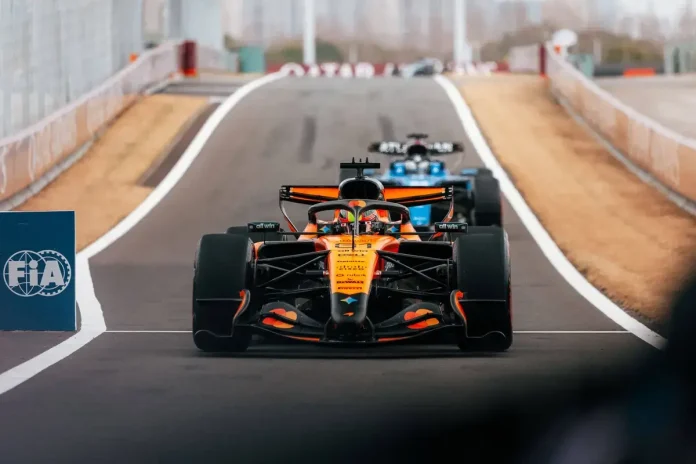
McLaren’s foray into the 2026 Formula 1 season has been nothing short of a disaster, leaving fans and analysts alike reeling from the shocking developments. The team’s title defense has commenced with a catastrophic failure, most notably the embarrassing withdrawal of both cars before the Chinese Grand Prix. This unprecedented double did-not-start incident stemmed from separate failures in a pivotal component of the Mercedes power unit, a part that lies beyond McLaren’s direct control. Team principal Andrea Stella expressed the team’s frustration, stating, “This is an area of the car which is not under McLaren’s control, so we rely entirely on what is reported by HPP [Mercedes High Performance Powertrains] and we trust completely their report.”
The gravity of the situation is stark. McLaren finds itself languishing in a perilous position, a staggering 80 points behind championship leader Mercedes, with a mere 18 points accrued from the first two races and a sprint event. This marks the bleakest start to a title defense in over a decade, eclipsed only by Red Bull’s disqualification woes in 2014. Strikingly, McLaren’s performance is even more disheartening when accounting for the additional points gained from a sprint race, making it the worst beginning for a defending champion since Ferrari’s disastrous point-less streak in 2009.
But the problems run deeper than just points. McLaren is grappling with a significant performance gap compared to Mercedes, despite sharing the same engine platform. On-track data has never been more crucial, and McLaren’s reliance on its Mercedes power unit is failing to yield results. Astonishingly, McLaren has completed fewer racing laps than the struggling Aston Martin-Hondas. The reliability issues that plagued Lando Norris in practice and led to Oscar Piastri’s unfortunate crash before the race have compounded the team’s woes. In Shanghai, McLaren’s vulnerability was laid bare, with Stella acknowledging the rarity of experiencing two terminal problems simultaneously.
While the works Mercedes team has faced its own reliability challenges, they have largely managed to avoid catastrophic losses. McLaren’s early season struggles raise questions about whether this is a persistent issue with their current package or merely a series of unfortunate coincidences. The team identified lost points as the most significant disappointment following the double DNS, emphasizing the necessity of staying competitive as the season progresses. Drawing parallels to 2024, when McLaren transformed from a midfield competitor to a title contender with a crucial upgrade, they are keen to replicate that success. However, the road ahead in 2026 is fraught with uncertainty.
The opening races of 2026 have served as a harsh reality check for McLaren. The stark contrast in performance during Melbourne qualifying highlighted a knowledge gap between the works team and its customers regarding the optimization of the power unit. McLaren’s struggles in qualifying, being over eight tenths slower than Mercedes, further underscore the challenges they face. Although they made strides in Shanghai, closing the gap to six tenths in sprint qualifying and half a second in the grand prix, it remains to be seen how they will fare over race distances.
Oscar Piastri noted a consistent theme of discovery in qualifying sessions, remarking that despite feeling they maximized their power unit potential, they often returned to find unexplained time losses. The team acknowledges that the works Mercedes squad has an edge in making immediate gains due to its unified structure. After an assessment post-Melbourne, McLaren estimated that approximately 50% of their deficit stemmed from a lack of understanding in exploiting the power unit effectively, with the remaining gap attributed to deficiencies in aerodynamic efficiency and grip.
Norris candidly stated that the current McLaren is not a podium contender, a reality they have not faced since the previous season. While there are echoes of challenges from earlier campaigns, the current circumstances are markedly different. Stella highlighted that the McLaren they currently possess is fundamentally sound yet underdeveloped, needing further refinement rather than a complete overhaul. The team is committed to accelerating development along established principles, aiming to catch up to the performance levels of Ferrari and Mercedes.
The shorter wheelbase of the 2026 McLaren, designed for improved balance, appears to compromise downforce, impacting the car’s ability to harvest energy efficiently. This design choice, while beneficial for weight distribution, has seemingly backfired in the face of competition. The upcoming races, particularly the Miami Grand Prix, are pivotal for McLaren as they plan significant upgrades to address these shortcomings.
Stella is optimistic, predicting substantial improvements in the coming races, and Norris echoed this sentiment, expressing hope for podium finishes later in the season. The extended break between races is viewed as an opportunity for the team to regroup and refine their strategies. McLaren’s commitment to rapid development is evident, but the challenge lies in outpacing every other team on the grid.
As the team prepares for the Japanese Grand Prix and the crucial Miami race, the pressure is mounting. Will McLaren reclaim its status as a formidable force in the championship, or will its title defense suffer a fatal blow? The answers await in the coming weeks, as McLaren aims to prove that it can still dominate the development race and return to contention before it’s too late.